Recommended Reads Books on Tank Destroyer Battalion 629th Wwii
The tank destroyer battalion was a type of armed services unit used by the United States Army during World War II. The unit of measurement was organized in one of two unlike forms—a towed battalion equipped with anti-tank guns, or a mechanized battalion equipped with armored self-propelled guns. The tank destroyer units were formed in response to the German utilise of massed formations of armored vehicles units early in WWII. The tank destroyer concept envisioned the battalions acting as independent units that would answer at loftier speed to big enemy tank attacks. In this role, they would be attached in groups or brigades to corps or armies. In exercise, they were commonly individually attached to infantry divisions. Over one hundred battalions were formed, of which more than half saw combat service. The force was disbanded shortly after the end of the state of war when the concept had been shown to exist militarily unsound.
Development of US tank destroyer doctrine [edit]
Groundwork [edit]

The 3-inch Gun M5 was the main weapon of towed Tank Destroyer Battalions. Afterwards the North African campaign, planners believed that towed guns were a better option than mobile units. This stance changed in the months following the Normandy invasion in 1944.
Tanks developed out the experiences of World State of war I, whereby the internal combustion engine was combined with steel armor plate, caterpillar tracks, cannons, and machine guns to produce a vehicle that could defeat the stalemate of trench warfare. Military doctrine in the interwar period was dominated by the possibility of using masses of armored vehicles on the battlefield. The original idea was that tanks would operate on a broad front with infantry, using their cannons and machine guns to knock out enemy positions.
In response to the threat of mobile armor, many countries had developed anti-tank guns, a form of towed, loftier-velocity artillery. These cannons fired armor-piercing rounds capable of penetrating the steel armor of tanks and incapacitating the crew inside. Further thinking focused on the possibility that tanks could also be used to fight enemy tanks. This resulted in a departure of blueprint in some countries, in which tanks were designed with either long-barreled small-quotient cannons capable of destroying other tanks, or with short-barreled, high-caliber howitzers used for directly fire infantry back up. These two pre-state of war classes of tank were designated every bit Cruiser tanks and Infantry tanks in the Britain and French republic[notes one] and were also present in early on German panzers and assault guns. Some tanks, similar the M3 Lee, were designed to fulfill both roles and were armed with ii cannons.
However, for many armies in that location was a separate between those in command of tanks and their doctrine, and those in command of anti-tank units and their doctrine. Since the first anti-tank guns were a form of towed artillery, it was the artillery branches which generally controlled these units, peculiarly in Britain and Germany. The armored branches of these armies were still dominated by the influence of cavalry-based thinking, and were focused more than on crime than the defensive need of anti-tank guns.
But in the opening offensives of the Second World War, the German success of armored forces full-bodied and used in a fast-moving offensive shocked armed forces observers. Even to armies which had previously experimented with large-calibration mechanized warfare, the effects were remarkable; the collapse of Poland in 1939, followed by the defeat of the French Army and the British Expeditionary Force in French republic in 1940, gave rise to an impression that massed tank forces were effectively invincible when used confronting unprepared defenders.
Mobile armor was, however, an expensive investment. Towed anti-tank guns were cheaper and dominated about armies as a default solution for enemy tanks and became organic parts of large units like corps, divisions and regiments. Standard exercise was to place these anti-tank guns at the front line, spread out to ensure full coverage. Notwithstanding, feel showed that neither infantry, anti-tank guns, or tanks, when used statically[notes two] could withstand the deep envelopment maneuvers of armored "spearheads". While some anti-tank guns or tanks could aid defend the expanse the enemy chose to attack en masse, they could never be enough to prevent the inevitable breakthrough. Moreover, anti-tank guns were vulnerable to infantry and artillery attacks, and even attacks from the tanks they were targeting.
As the war progressed, so did engine and armor technology, creating faster and more heavily armored tanks. Small quotient anti-tank guns (like the 3.seven cm Pak 36 in Germany and the 37 mm Gun M3 in the US) were increasingly obsolete. This forced designers in all participating countries to create larger caliber cannons capable of firing both anti-tank rounds and high explosive rounds. Nevertheless, the problem of massed attacks remained.
To counter this threat, Nazi Germany congenital on the already existing Sturmgeschütz ("assault gun") range of armored vehicles. These relatively inexpensive assault guns had no turrets and were under the control of the artillery branch, and were substantially armored artillery cannons mounted on or in a tank chassis. Originally curt barreled, these vehicles were upgraded with longer, college velocity cannons, which made them more effective against armor without taking much away from their directly fire infantry back up mission. As a result, they were used effectively against Soviet armored thrusts on the Eastern forepart. Additionally, Germany as well developed the Jagdpanzer ("hunting tank") range of armored vehicles, very like in design to assault guns but with the main purpose being the destruction of enemy armor. They could also function as mobile assail guns when required, blurring the line between the ii designs.
The Soviets, seeing the reward in such vehicles, too developed their own versions.
But by the fourth dimension the Usa entered World State of war 2, it had neither the quality nor the quantity of armored vehicles capable of fighting a modern war, including the ability to deal with massed armored attacks past an enemy on a narrow forepart.
Development [edit]
In April 1941, a conference focused on the hereafter of antitank operations. The firsthand effect was to create an anti-tank battalion in infantry divisions, just this organic anti-tank chapters was not deemed sufficient. The conference gave broad support to the thought of creating mobile anti-tank defensive units (commanded by corps or army formations) which could be deployed to encounter an armored attack. The try stalled on the effect of which branch of the Army should control information technology—the infantry (every bit a defensive office), the cavalry (as a mobile response forcefulness), or the artillery (equally heavy guns). The armored branch did not press for command of the anti-tank units, feeling that it would be at odds with their general principles of maintaining the offensive. In May, General George C. Marshall cut through the knot by declaring the issue as sufficiently of import to be dealt with as a combined-arms organization, forming an Anti-Tank Planning Board headed by Lt. Col. Andrew D. Bruce, and appointing Brigadier Full general Lesley J. McNair to take immediate action on organizing anti-tank forces. Three anti-tank "groups" were chop-chop organized, with each of three anti-tank battalions fatigued from infantry divisions and various support units, and tasked with "speedy and ambitious activity to search out and attack opposing tanks earlier they had assumed germination".[ane] In August, a plan was laid out for a plan of 220 anti-tank battalions.[notes 3]
The first nine units were deployed during the Louisiana Maneuvers of 1941, equipped with towed 37 mm anti-tank guns (the largest gun that could exist towed by a jeep) and surplus 75 mm M1897 guns mounted on one-half-tracks (the M3 Gun Motor Carriage), and again in the Carolinas maneuvers that November. Their employment was judged a success—though not without some disgruntled voices in the armored co-operative arguing that the umpires had rigged the results[2] — and on 27 November, Marshall ordered the institution of a tank destroyer Tactical and Firing Centre at Fort Hood, Texas, under Bruce, and the activation of 53 new anti-tank battalions under the command of General Headquarters. The term "tank destroyer" was used from this bespeak on, as it was seen every bit a more than psychologically powerful term. On 3 December, all existing anti-tank battalions were reassigned to General Headquarters and converted to tank destroyer battalions. The new tank destroyer doctrine was formally stated in Field Manual 18–5, Tactical Employment, Tank Destroyer Unit, in June 1942. It laid downward a focused doctrine— "In that location is but one objective of tank destroyer units… the destruction of hostile tanks"[ citation needed ] —and repeatedly emphasized an offensive, vigorous spirit. Tank destroyer units were expected to be employed as consummate battalions, held in reserve and committed at critical points, rather than parceled out every bit small defensive strongpoints. The emphasis was heavy on mobility, and the ability to outmaneuver the attacking armor; this would feed into vehicle design, and cause the speed of a vehicle to be prioritized over survivability.
One side-effect of the new status of the tank destroyer force was that, as a fully-fledged independent co-operative, it was required by War Section policy to establish units manned by African Americans – the Usa Regular army remained racially segregated until the Korean State of war, merely the War Department placed pressure on the Army to ensure that a fair proportion of gainsay units were black. Two of the initially converted battalions were blackness, with another four created in 1942 and 4 (of a planned six) in 1943. Several would eventually encounter combat, and one would become the first blackness unit to receive a Distinguished Unit Citation.[notes four] [3]
Tactics [edit]

Basic Usa Tank Destroyer doctrine: German armor breaks through United states lines. A tank destroyer battalion responds by moving into the path of the advance. The units then position themselves to burn at the advancing tanks from hidden positions.
US tank destroyer doctrine was essentially a defensive and reactive measure. They existed to deadening down, or even stop, a Blitzkrieg style armored thrust and prevent it from penetrating besides deeply or from encircling friendly forces in a pincer movement. The idea was that, one time an enemy armored thrust was expected to break through, the tank destroyer battalion (as a unmarried unit and operating behind the front lines), would position itself to intercept the enemy while a more complete defense is organized at corps or higher level. This was to be the case for both towed and mobile tank destroyer battalions. As the enemy armored thrust approached, organic reconnaissance units would communicate to battalion commanders the best locations for tank destroyer units to place themselves in, while organic pioneer units would create blockades or assistance the tank destroyers dig into their positions. Every bit the enemy armored thrust came inside range, the hidden tank destroyer units would fire upon enemy tanks and then retreat to some other position once they began to draw fire.
In the criminal offense, mobile tank destroyers were not given the duty to hunt down enemy tanks,[notes 5] every bit this would be the office of their ain tanks. Instead, they were to be positioned close to the advance to cease any counter-attacking armored strength.[4] [notes half dozen] Towed tank destroyer units had no offensive function in an armored thrust, and were given the task of supporting infantry units or being used as indirect fire units to augment arms. Mobile tank destroyers were also allowed to support infantry operations, or even function in an indirect fire role, and so long every bit their principal mission was not compromised.
In terms of vehicle design, mobile tank destroyers were to exist heavily armed, but with speed given priority over armor protection. Different tanks, mobile tank destroyers were not designed to survive hits from enemy AP rounds, but to mainly resist small-scale arms burn down. Crews were also trained to hide their vehicle from enemy burn.
Organization [edit]

Tank Destroyer Battalion (SP) Structure - March 1944. The Battalion consisted of three companies of twelve vehicles each, plus a motorised reconnaissance visitor that also included a pioneer (engineer) platoon.
3 initial organizations were laid downwards in December 1941; two were lite organisations equipped solely with 37mm guns, and were abandoned equally shortly as possible to standardise on the 3rd blazon, modeled after the 893rd Tank Destroyer Battalion, and officially declared the standard organization with the publication of FM 18–5 in June 1942. This was designated the "tank destroyer battalion, heavy, self-propelled", and consisted of:
- A headquarters company
- A reconnaissance visitor (including a pioneer platoon),
- Three tank destroyer companies of twelve vehicles each
The three tank destroyer companies each had one platoon of four 37mm self-propelled guns and two platoons of 75mm self-propelled guns. Each platoon had ii sections of ii guns each, an anti-aircraft section of two self-propelled 37mm guns, and a "security section" of twelve infantrymen. This gave a total of twenty-four 75mm guns, twelve 37mm guns, eighteen anti-shipping guns, and 108 security troops. The vehicles used were the M3 GMC, with a 75mm gun, and the M6 GMC, a 3/four ton 4x4 Dodge truck with a 37 mm gun mounted in the rear compartment facing to the rear.[5]
The battalions deployed to Northward Africa used this organisation, with both heavy and light anti-tank guns, only as reports from Europe indicated that low-cal anti-tank guns were no longer playing a significant part in gainsay, the light platoons were converted to a third "heavy" 75mm gun platoon under a new organization issued in November 1942.[5] As M10 tank destroyers came into use, with a three-inch gun, these replaced the 75mm gun-equipped M3 GMCs.
By 1943, the role of tank destroyer battalions was becoming improve understood, and the early on ideas of mass employment of tank destroyer units had become obsolete. As a result, the number of battalions planned was steadily reduced, and the manpower and equipment assigned to them was reduced. A new tabular array of organisation produced in Jan 1943 reduced the overall manpower by 25%, by eliminating the anti-aircraft units (which had proven unnecessary), reducing the number of supporting units, and combining the tank destroyer platoon'southward headquarters with its security department. At that place was no reduction in actual gainsay force.[6]
In early 1943, stemming from bug found in N Africa, the Army began to consider a more than defensive role for tank destroyer units. Afterward trials in January, fifteen battalions were ordered to convert to towed guns on 31 March, and shortly thereafter information technology was decided that half of all tank destroyer units would convert to a towed organization. The broad outline of the battalion remained – three companies of three platoons of four guns – but the reconnaissance visitor was downgraded to two platoons in the headquarters company. Nevertheless, the demand for larger gun crews and more security troops meant that the manpower of the unit of measurement increased once more. These units were equipped with iii-inch M5 guns towed past trucks or M3 Halftracks.[7] However, combat feel in Normandy and Italia – coupled with the fact that purpose-congenital M18 Hellcat and M36 tank destroyers were becoming available – showed that the towed units were underperforming compared with self-propelled ones. After the Ardennes campaign, where 85% of all tank destroyer losses were towed guns, it was decided to convert all towed units back to self-propelled guns.[8]
Reconnaissance and Pioneer Units [edit]
The Reconnaissance company of the tank destroyer battalion was made up of three reconnaissance platoons and one pioneer platoon, forth with supporting units.
The reconnaissance platoons had two primary missions for the battalion'south tank destroyer units: "Road reconnaissance, particularly of those routes over which the gun companies will movement to reach combat areas", and "Area reconnaissance, particularly to locate general areas suitable for use as combat areas by the gun companies".[9] Other missions included zone reconnaissance, battle reconnaissance, security missions and counter-reconnaissance.[notes 7] Each platoon had two M8 Greyhound armored cars and 5 1/4 ton trucks (Jeeps). In the context of Tank Destroyer doctrine - that the battalion be placed in the path of an enemy armored thrust - the reconnaissance platoons served to seek and locate areas for tank destroyer units to ready.
The pioneer platoon had two full general missions: to prevent the movement of the battalion from being delayed by natural or artificial obstacles, and to impede or canalize the movement of the enemy past the cosmos of obstacles. The pioneer platoon consisted of a platoon headquarters and two sections, each section included ten men and two 1 1/2-ton trucks equipped with pioneer tools and equipment; the platoon headquarters consisted of six men, a car armored, utility (M20), and an air compressor (MT2) consummate with all its various air powered tools.[10]
Since neither the pioneer nor reconnaissance units were able to function every bit originally intended (run across below), they were ofttimes attached to other units (such as engineering battalions or cavalry reconnaissance squadrons) that operated under the division or corps that the tank destroyer battalion had been assigned to.
Combat feel [edit]
North Africa [edit]

The M3 Gun Motor Railroad vehicle (M3 GMC), which mounted a 3-inch gun on a half track, was the first effective mobile US tank destroyer.
During the Tunisian Entrada of 1942–1943, the US forces would employ seven tank destroyer battalions.[notes 8] All the same, contrary to doctrine they were invariably cleaved up down to the platoon level to support infantry units. On the one occasion where a tank destroyer battalion was employed as an organized unit of measurement—the 601st, at the Battle of El Guettar—it defended against an attack past the 10th Panzer Division, destroying 30 of its 57 tanks.[notes 9] This engagement had the distinction of being the merely time a battalion would fight in the way envisaged by the original "tank destroyer" concept, as an organized independent unit of measurement opposing an armored force in open terrain. The 601st lost 24 of its 36 M3 GMC tank destroyers.[11]7 M10 tank destroyers from the 899th tank destroyer battalion were likewise lost in the battle.
Disquisitional assay of the new strength was mixed; while the 601st had successfully repulsed the assail, it had lost ii-thirds of its force in the process, contributing to Major General George Patton'due south annunciation that the concept was "unsuccessful in the atmospheric condition of the theater".[12] McNair responded by further clarifying the role of the tank destroyer—it was to exist a highly mobile force, which sought to find and occupy favorable positions to engage an oncoming enemy attack. A tank destroyer "demand only to maneuver for a favorable position, conceal itself thoroughly and ambush the tank"[12]—it was not intended to exist used in a frontal offensive, or in assault in gainsay like a tank.
Training issues were also exposed. Mobile Tank Destroyer units had not been trained to work together as a battalion - despite the doctrine being so conspicuously to the fore, actual training of the units was done at a minor unit level. As well at issue was the functioning of the organic reconnaissance units, who had never experienced such extended distances in grooming equally they were forced to operate in N Africa. With an inability to piece of work together as a battalion, along with the poor performance of the organic reconnaissance units, many vehicles were lost in the Battle of El Guettar.[13]
Major changes to the overall doctrine emerged from the Due north African entrada.
Flaws had emerged in the M3 GMC and M10 tank destroyers—they were not fast plenty, and had an overly high silhouette which made them vulnerable to direct enemy fire. Major Full general Omar Bradley, then commanding the U.S. Two Corps in Due north Africa, suggested that towed anti-tank guns could be reintroduced to infantry units—while it was feared this would atomic number 82 to a lack of offensive spirit, it was undeniable that a small towed gun could be dug in very quickly and efficiently, giving a very low-contour target, though a large gun sometimes took a day to fully set up. Bradley'southward proposal was not, however, intended to create towed TD battalions. His intent was to put the anti-tank assets in the easily of infantry units. The fact that the British Army had had success with dug-in antitank guns supported his proposal, and an experimental battalion was established in the summer with three-inch guns. This apace gained popularity—heavily supported by McNair—and in November 1943 it was ordered that half of all tank destroyer battalions were to be equipped with towed guns; this was a major distortion of Bradley'due south proposition.
The expected employment of the battalions shifted. While the formal doctrine still called for the employment of consummate battalions, the Tank Destroyer Center began to emphasize a new focus on combined artillery training and small-unit of measurement actions. New field manuals were prepared to discuss the independent operation of tank-destroyer platoons, and crews began to have specialized training in their secondary roles, such every bit indirect gunnery or anti-fortification work.
Changes in training were fabricated to ensure that tank destroyer units acted according to operating process. This was necessary considering too many tank destroyer units in North Africa were "behaving like tanks"[xiv] and attacking High german tanks "head-on", despite their lack of armor. Further training changes involved the role of the organic reconnaissance companies, which were not adequately performing their assigned tasks: route and area reconnaissance with the specific aim of finding locations for tank destroyers to ambush approaching enemy tanks.[xv]
Sicily and Italy [edit]

A M10 of the 701st TD Btn advancing along a mountain road, in an example of the broken terrain mutual in Italy
There were not enough anti-tank guns to encompass the frontage and notwithstanding have depth. That left gaps in the AT defenses that were filled past bringing tanks and tank destroyers way forward. These were such big targets, since they could non be dug- in, that many of them were knocked out past German 88mm guns and Mark VI tanks. As a result we lost some ground to tank-led attacks. And so we put all our anti-tank guns right in the forepart line wherever they could be dug-in to cover the front. We placed the tanks and tank destroyers well dorsum but ready to move up to reinforce the anti-tank guns. Afterward we took this activity, nosotros stopped all the tank-led attacks cold.
—Executive Officeholder, 15th Infantry Regiment, quoted in U.S. Army, Headquarters Mediterranean Theater of Operations, Preparation Memo no. 2, "Lessons From the Italian Campaign", p. 69
The second theater of operations for tank destroyer units was the Italian campaign, first with the landings in Sicily in July 1943, and standing into mainland Italy that September. While German armor was present in the theater, information technology was rarely committed to battle in large groups; this was partly a result of the cleaved, heavily cultivated, terrain, simply also due to a growing conservatism and defensive ethos on the German side. As a event, the tank destroyers constitute themselves used for a variety of other tasks, most commonly local arms back up.
A report in belatedly 1944, reviewing the use of tank destroyer units in gainsay, found that in practice they were often expected to fulfill the roles of armor support:
During the planning phase for an assault it was constitute that practically without exception the infantry commanders were reasonable in their requirements and expectations of back up by the tank destroyers. But in one case the battle was joined, the original plans with few exceptions were oftentimes discarded and the destroyers were ordered to go forrard as tanks ahead of the infantry...[16]
When operating with armored forces, it was common to attach a visitor or a platoon to a tank battalion or company, and utilize them in an overwatch part. When operating in defense, tanks and tank destroyers were pooled as a rear-area reserve and brought into the line to blunt tank-led attacks against infantry positions.
A major lesson learned from the Italian entrada was that the conversion to towed guns was not as advantageous as had been previously thought. The mobility and protection of the tank destroyer was found to outweigh the towed anti-tank gun's depression contour. At Anzio, a number of British towed anti-tank gun units were overrun and knocked out simply because they were unable to redeploy on brusque detect, while cocky-propelled guns were able to autumn back and continue fighting.
In Italy, the last few M3 GMC were replaced by the M10. Although the M10 was incapable of dealing with the frontal arc of the rarely-encountered Panther tanks and Tiger tanks, it was sufficient against most enemy armor encountered in Italia, and confronting heavy tanks from the flank. The M18 was first deployed in the summer of 1944, and was not seen as a bang-up success in the Italian theater; its high speed was only of limited use in the restricted terrain, and as a result information technology was effectively a slightly upwardly-gunned M10.[ citation needed ]
Tank destroyer forces reduced [edit]
In Baronial 1942, the Tank Destroyer Command was redesignated the "Tank Destroyer Centre," representing a "abrupt restriction of authority" to purely a training establishment, with tank destroyer battalions leaving the custody of the Eye entirely after their preparation was finished. From a high of 220 battalions, now deemed excessive, the 1943 troop footing called for only 114. In Apr 1943, it was called for that only 106 battalions be activated, the number active or in the process of activation at that time. By October 1943, it was found that the need for tank destroyers overseas was far less than had been expected, and the Tank Destroyer Center began to reduce its training activities.
Thirty-five tank destroyer battalions never left the Usa. Twenty-five battalions were cleaved upwards in 1943 and 1944 for their manpower, either to reinforce existing battalions, for assignment to special not-divisional infantry regiments for a six-week period of training to be converted to infantry replacements (the bulk of the battalions), or were kept occupied with miscellaneous tasks such as serving every bit school troops, until their inactivation. 10 battalions (not counting one that did so while overseas) were converted to other types of units, importantly tank, amphibious tractor, or armored field artillery battalions.[iii]
Northwest Europe [edit]
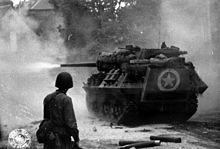
M10 tank destroyer in action most Saint-Lô, June 1944.
In countless operations, mobile guns with armor protection used these characteristics to their decided advantage. They could move in or out of position freely; in combat, towed weapons waited for nightfall (except in extreme emergency) earlier moving, and one time committed had little opportunity for their thin-skinned prime number-movers to change them to another position. Towed guns had a express traverse, compared to the vehicular weapon, and their prime number-movers were of trivial assistance in altering their traverse. The vehicular weapon could follow the advance of infantry or armor, or become a function of the forward elements of the assault, all well beyond the capability of the towed gun..
—William F. Jackson (Major) et al.
Employment of four tank destroyer battalions in the ETO. May 1950 p 171-172 of 188
By far the largest employment of tank destroyer units was in the n-western Europe campaign through France, the Depression Countries and Deutschland. They were employed from the very beginning of the campaign, with one battalion beingness landed on Utah Beach in a follow-up wave on D-24-hour interval.
A revised version of Field Manual xviii–v, introduced in June 1944, broadened the doctrine of tank destroyer operations. It allowed for a more dispersed deployment of the battalions throughout a forcefulness, and recommended that when enemy armor was only expected to be deployed in pocket-sized groups, tank destroyers were to be distributed among forward units. It became general exercise to adhere a tank destroyer battalion semi-permanently to a sectionalisation; this meant that it was locally available for emergencies, and that information technology would be able to train aslope "its" division when out of the line.
The most significant employment of tank destroyers in Normandy was in early August, at the Battle of Mortain, where the 823rd Tank Destroyer Battalion (towed 3-inch guns) was on the defensive alongside the 30th Infantry Division. The division, which was in temporary positions and non prepared for a defensive engagement, was attacked by elements of four panzer divisions on 6 August, under heavy fog. The 823rd put up a strong defense force—knocking out xiv tanks—but took heavy losses, being generally overrun and losing eleven guns. This served to reinforce misgivings about the effectiveness of the towed units, and a written report delivered to the Pentagon in December recommended they be phased out in favor of self-propelled units.
It was in France that the allies first began to face the German Panther tank. The superior frontal armor of this tank, along with the Tiger I, Tiger 2, and newer Panzerjägers, fabricated the 75mm armed US tanks and tank destroyers less effective. The presence of these German tanks expedited the development and production of US armored vehicles armed with 90mm guns - the first to exist introduced being the M36 tank destroyer.
Battle of the Bulge [edit]
In Dec 1944, and January 1945, the Battle of the Bulge put American basis forces on the operational defensive for the beginning time in Europe, equally a German army group of 24 divisions (including x panzer divisions with one,500 armored vehicles) launched a major offensive in the Ardennes woods. The main thrust fell on the 99th and 2d Infantry divisions which jammed the northern shoulder. A secondary assail hit ii overstretched infantry divisions, both with attached towed tank destroyer battalions.[notes ten] One time contact was fabricated, the towed guns were unable to reposition themselves or withdraw, and were often overrun by the enemy advance, or simply outflanked by infantry.[notes 11] The gun crews, unlike their self-propelled counterparts, had no protection against small-arms fire, and could easily be driven back by a squad of infantry. This lack of mobility was aggravated past the cold wet atmospheric condition, and the rough conditions, which tended to bog down wheeled vehicles and immobilize fixed guns. Throughout the 1st Regular army as a whole, 3-quarters of the tank destroyers lost were towed rather than cocky-propelled. One battalion, the 801st, lost 17 towed guns in merely 2 days, while the M10-equipped 644th, which fought aslope it, establish ideal opportunities for close-range ambushes and claimed 17 tanks in the same time period. Information technology was articulate that the towed guns had proved ineffective and, in one case the Ardennes offensive had been dealt with, the U.S. State of war Office canonical Eisenhower's Jan 1945 asking to convert all remaining towed units in the theatre to self-propelled guns.
Despite US forces being subjected to a major armored thrust past the Germans in the Ardennes, Tank Destroyer units were not ordered to appoint the enemy according to stated doctrine. This was because well-nigh units had already been fastened to Divisions and had been broken upward into smaller infantry support units in a similar way to the style separate Tank Battalions had been. Moreover, the loss of lines of communications led to the smaller units being controlled by local commanders rather than beingness directed past Corps or Ground forces commanders.
Northern Sector - Kampfgruppe Peiper Still, tank destroyers were to be found throughout the fighting in the Battle of the Bulge, fighting at close range in cleaved terrain much as they had done in Italian republic, and, despite their shortcomings, were an essential part of the successful defense. They were widely used during the Ardennes fighting, especially in the northern sector around Malmedy, Spa, Stoumont. Large numbers were involved in several actions against the tanks of Kampfgruppe Peiper, the spearhead of the German 6. Panzer Army, around La Gleize. Elements of the 740th Tank Battalion and 823rd Tank Destroyer Battalion closed from Remouchamps were deployed into defensive positions in front of Stoumont alongside elements of the 3rd Armored division, the 30th Infantry Sectionalisation and the 82nd Airborne Partitioning.[17]
The battle was also the first major engagement of the M36, with its 90 mm gun; the three battalions employed (the 610th, 703rd, and the 740th Tank Destroyer Battalions) proved highly constructive. The M36 was first to exist introduced in number when the offensive began, and was important throughout the unabridged Ardennes offensive.
Southern Sector - Bastogne The 705th, equipped with M18s, fought alongside the 101st Airborne at the siege of Bastogne, and played a central part in the defence of the boondocks. Iv M-18s, along with some M4 medium tanks and infantry from the tenth Armored division, occupied Noville, simply due north of Bastogne, and stopped a German armored attack with flank fires, killing xxx heavy tanks (Panthers and Tigers).[eighteen] Once surrounded, the actions of mobile Tank Destroyers inside Bastogne was similar to stated doctrine - whenever German attacks threatened the front lines, tank destroyer units (along with Us tanks) would rush to the area from backside and intercept invading armor. Because of the shortness of the interior lines inside the besieged Bastogne, Tank Destroyer units could be directed very quickly to whatsoever location in response to a German attack and prevented whatever breakthrough.[xix]
The battle also highlighted the defensive nature of Tank Destroyer tactics compared to regular armored units. During Squad Desobry's initial occupation of Noville, a number of US tanks and tank destroyers were firing into advancing units of the 2nd Panzer Sectionalisation. However, and then many targets were appearing that the M4 tanks from CCB of 10th Armored were staying in place and not moving. By contrast, the M18s from the 609th Tank Destroyer Battalion made frequent changes in location later firing. As a event, tank losses were high while Tank Destroyer losses were comparatively low.[xx]
Fundamental Sector - St. Vith The mobile defense of the Boxing of St. Vith involved M36 tank Destroyers from the 814th Tank Destroyer Battalion blunting High german armored thrusts. Once these thrusts were halted, tank companies from the seventh Armored Division would counter-attack. This tactic immune a gradual retreat of United states of america forces, ceding only a few kilometers a day, and was instrumental in ruining the plans of advancing High german forces.
While the tank destroyers were broadly used in their intended role in the Ardennes—being used as a reserve to counter a massed armored attack – there were two significant differences between their use and the original doctrine. Firstly, there was no central strategic reserve—near tank destroyer battalions were assigned to divisions and kept near the front line, rather than massed in the rear. Secondly, the battalions were rarely committed as a whole; as had become common, they were finer used as local anti-tank assets, with a platoon or a visitor assigned to an infantry battalion to eternalize its defensive strength.
Infantry support [edit]

Soldiers of a tank destroyer battalion warm themselves with java before going into action against the Germans well-nigh Stolberg, Frg. sixteen November, 1944.

M36 of the 702nd Tank Destroyer Battalion engaged in indirect burn down duty, xvi December 1944.
After losses in the Boxing of the Bulge, High german armored capability in the Westward was seriously weakened, both through combat losses and through logistical limitations. As such, the tank destroyer battalions spent the closing months of the war every bit mobile support units, broadly distributed into secondary roles.
As a consequence, mobile tank destroyer forces generally operated in the same manner as the separate tank battalion - being used every bit direct burn support for infantry operations beyond a broad front. Simply while tanks were effective in this role, the tank destroyers were handicapped past their open turrets and thin armor, making them more vulnerable to enemy fire. Moreover, the speed reward that some tank destroyers had over tanks did not interpret into a tactical advantage since such support operations moved at the speed of foot infantry. Infantry units did, nonetheless, appreciate the support of tank destroyers in lieu of available tanks.
The remaining towed tank destroyer battalions were generally attached to infantry divisions in more static areas, offering limited direct fire support in the same way as the mobile battalions, or else beingness attached to divisional arms to broaden indirect fire missions.[21] Most of the towed battalions were gradually refitted with mobile units subsequently the Ardennes and retrained.
Past the state of war's end, infantry division commanders "unanimously agreed that they would adopt to have the back up of a tank battalion instead of a tank destroyer battalion."[22] The result was a belief that each infantry division would have its own dedicated battalion of iii tank companies, with each company serving each of the iii Infantry Regiments. This made the Tank destroyer doctrine obsolete, since tanks themselves could too serve in the role of a mobile anti-tank defense against any potential enemy armored thrust, a tactic that had been proven during the Ardennes.
Pacific campaign [edit]
A small number of tank destroyer battalions served in the Southward-West Pacific; due to the lack of Japanese armor, these were employed most entirely in the infantry support role, effectively acting as highly mobile artillery. Due to their open-topped turrets, the tank destroyers were far more than vulnerable than tanks to close-assail tactics used by the Japanese infantry.
Tank destroyer forces disbanded [edit]
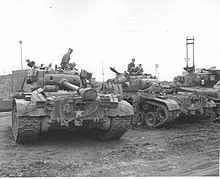
M26 Pershings; a powerful heavy/medium tank which finer made the specialist tank destroyer obsolete
The United states Army finished the war with 63 agile tank destroyer battalions, mostly self-propelled.
While tank destroyers had proven their versatility and efficiency in combat, especially in secondary roles, their long-term utility was condign doubtful by 1945 in light of changes to Ground forces doctrine. Their master role was to destroy enemy armor, just this function was being usurped by tanks, equally had already happened in many other armies. The about powerful tank destroyer to be fielded, the M36, mounted a 90 mm gun; the aforementioned ammunition was carried by the M26 Pershing heavy tank, which was first to attain forepart-line units by the finish of hostilities. The M26 was redesignated every bit a medium tank presently after the cease of the war, condign the standard vehicle of armored units, and farther reducing the need for any specialist anti-tank capacity. In effect, tank destroyers were used just like tanks in many cases. Study of ammunition expenditures shows that tank destroyers in Europe fired most 11 rounds of loftier-explosive (HE) ammunition for every circular of armor-piercing (AP) ammunition, showing that they were used for full general support duties far more than oftentimes than as anti-tank assets.[ citation needed ]
Moreover, the tactics that underpinned the creation and training of tank destroyer battalions had been undone past the experiences of the Ardennes. Stopping or slowing a blitzkrieg way armored thrust became the responsibility of combined-arms formations, in which infantry, artillery and armor worked together in a mobile defense. While tank destroyers fabricated up an important part of such a defense, it became clear that tanks were ameliorate suited considering of their all-round ability to counter-attack an enemy, as well as provide a mobile defense, of which they were equal to the tank destroyers (with the exception of the M36).[ citation needed ] Tank destroyers, being lightly armored, were not suited to a counter-attacking role, and were limited to providing mobile defence force only.[notes 12] The confusion of the Ardennes boxing also resulted in the creation of many advertizing hoc infantry/armor formations, which was in contrast to the tactic of having tank destroyers in a well organized formation situated well back from the front end lines. The result of this experience led military strategists to conclude that neither static anti-tank positions at the front line, nor mobile battalion-sized tank destroyer units operating in the rear, were the best solution to enemy armored thrusts.
Defensive measures were also informed by the feel of Soviet Deep operation activities on the Eastern Front. Seen especially in the Battle of Kursk, big numbers of Soviet infantry and armor were arranged in various deep echelons to blunt German advances and prevent breakthroughs.
In improver, the Ground forces was reducing its size very apace after the end of hostilities; the tank destroyer branch price the equivalent of three or four total divisions, a definite luxury for a non-essential service. The 1945 General Board written report "Study of Organisation, Equipment, and Tactical Employment of Tank Destroyer Units" led to the disbandment of Tank Destroyer Battalions,[23] and on ten November 1945, the Tank Destroyer Middle was closed, effectively ending the long-term prospects of the force. The last battalion was de-activated in 1946.[ citation needed ]
Towed or mobile? [edit]
Ane of the more perplexing aspects of US tank destroyers and the military doctrine underpinning information technology was the relative success and failure of both towed and mobile units: the N African experience clearly indicated that towed tank destroyer units were superior, yet the European experience clearly favored mobile tank destroyer units.
Ane factor in this problem was developing tank technology. The High german tanks that fought in North Africa were not the same ones that defended Western Europe. Panthers, in detail, were heavily armored and relatively fast. The 75mm guns of towed and mobile tank destroyer units that had defeated Panzer Ii and Iii tanks in Due north Africa plant information technology more hard to defeat Panzer IV and V tanks in Western Europe. This was a trouble that affected the entire allied war effort and not just something which affected tank destroyers exclusively. Nevertheless, the only US weapon that could be counted on to defeat heavy German armor was the 90mm gun that was mounted on the M36 Tank Destroyer and M26 Pershing heavy tank, the latter being introduced too late to have any meaningful affect on the war. What this meant was that the towed battalions, supplied just with 75mm cannons, did not take the same advantage equally the mobile battalions had when they were supplied with the 76mm and 90mm cannons of the M18s and M36s.
Geography also played a very of import part in this problem. N Africa was more often than not dry and flat and units could appoint one another at maximum range. The M3 GMC and M10 tank destroyers in North Africa had high silhouettes and were an easier target than towed cannons, which were dug in and often camouflaged. By contrast, the Western European front end was brindled with towns, forests, bocage, hills and gullies, and farmland, also equally rain, snow and fog to reduce visibility. Engagements were thus at a closer range than in North Africa, which made towed units more vulnerable, especially to small arms fire from infantry units accompanying armor.
Moreover, experiences on the Eastern Front by both High german and Soviet towed anti-tank guns reinforce the importance of battlefield geography. The successful Pakfront tactic was developed by the Germans and was copied by Soviet forces. Pakfront was similar in nature to US towed tank destroyer strategy, whereby big numbers of towed anti-tank cannons were placed in an area that enemy armor was expected to get through. What made Pakfront unique was that these hidden cannons would and so according their burn upon a single armored vehicle (unremarkably command tanks) with the intention of causing a catastrophic impale. Pakfront was successfully used by the Soviets during the Battle of Kursk. It is important to note that the fighting terrain on the Eastern front end was often fought on the flat expanses of the steppe, which, like North Africa, immune units to appoint at maximum range.
Vehicles [edit]
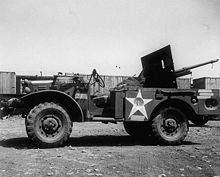
The M6 Gun Motor Carriage was a 37mm gun attached to a Dodge WC52. It was too lightly armed and armored to be an effective tank destroyer.

All US tank destroyers were built without turret roofs
US Tank Destroyer doctrine called for mobile units to quickly move to a given position, fire upon enemy armor once they were inside range, and then to retreat quickly and take up another position when endangered past enemy burn. Design specifications were thus geared towards speed and mobility, turreted ammunition capable of defeating enemy armor, and only plenty armor to resist pocket-sized arms burn. This was in contrast to the slower Russian and German tank destroyers, which were heavy armed and armored and were congenital without turrets.
Some early on units were equipped with towed 37 mm guns, but this was speedily abandoned. In addition to the 75 mm-equipped M3 GMC, the original endeavour to produce a tank destroyer, a vehicle was developed utilizing the mutual 37mm anti-tank gun. This was designated the M6 GMC, and was simply a 3/iv ton truck with a 37 mm gun mounted in the rear compartment. A big number were produced, equipping one platoon in each company, but this was abased after Nov 1942 and the vehicles exchanged for M3 GMCs. The M6 saw just express service in N Africa, and was declared obsolescent in 1943. A few were used by Free French forces in Europe in 1944–45, and the 37mm gun mounts were added to a few M2 halftracks at the unit level.
The deficiencies of the M3 GMC were quickly noted in the 1941 maneuver, and the experience gained allowed a "perfect" advanced tank destroyer to exist planned, one which would give a loftier priority to speed. Yet, it would take some time to be developed, and a simpler pattern was looked for equally a stopgap. It was decided to take the proven M4 Sherman chassis and requite information technology a modified 3 inch loftier-velocity anti-aircraft gun; the resulting combination was designated the M10 Gun Motor Wagon. Compromises were made to the vehicle; the turret was left open up and lightly armored, keeping the weight low in order to prioritize the speed of the vehicle. A small number were used in N Africa, and information technology became a standard vehicle thereafter.[24]
The experience of employing the M3 GMC, M6 and M10 in Northward Africa all fed into the plans for the adjacent generation tank destroyer, which somewhen saw service as the M18, nicknamed the "Hellcat". It was equipped with a newly designed 76 mm gun—firing the aforementioned shell (from a different cartridge case) equally that on the M10—mounted on an all-new chassis. This new design allowed it to be ten tonnes lighter than the M10, which allowed for a remarkable route speed of over 50 mph. Withal, it was all the same lightly armored—indeed, it had only half the armor of the M10—and suffered many of the survivability problems of its predecessors. The M18 began to run across service in mid-1944.
The final tank destroyer to enter service was the M36. This was a development of the M10 hull with a new turret mounting a ninety mm loftier-velocity gun, the nigh powerful anti-tank weapon which would be carried by American forces in Europe. A prototype was originally constructed in 1942, every bit an experiment, and the design was standardized in June 1944. In July, the European control requested that all M10 battalions be converted to M36s, and the outset vehicles reached the forepart lines in September. It proved more than capable of countering heavy tanks – it was recorded as disabling a Panther tank at 3,200 yards – and its roots in the M10 meant that it possessed greater survivability than the M18.[25] A modification of the M18 upgunned to 90mm was never canonical for series production.
Design [edit]
All the U.s.a. tank destroyers were congenital without turret roofs. This was done to salve weight only also allowed a wider field of view to spot enemy armor[12] and quicker ammunition stowage. The drawbacks included vulnerability to modest arms fire (especially from elevated positions), grenades, and splinters from air bursting artillery.[26] Exposure to wind, rain, snow and freezing temperatures also fabricated operations difficult, and many tank destroyer crews placed tarpaulins or other material over the turret to improve both their comfort and their operational effectiveness.[27]
Battalion numbering [edit]
Nether the initial scheme outlined in December 1941, when antitank battalions created from assets that came from infantry divisions were converted to tank destroyer battalions, they received a number in the 600 range. Antitank battalions created from armored division avails received numbers in the 700s. Separate infantry antitank battalions (irrespective of the arm of the cadre source) and those created from antitank assets of non-divisional field artillery units received numbers in the 800s. Towed and cocky-propelled units were often noted past (T) or (SP) beingness appended to the number.
See also [edit]
- Cruiser tank
Notes [edit]
- ^ With exception of Matilda I, British cruiser and infantry tanks were armed with the same gun initially a 40mm QF-2pdr gun, then later the 57mm 6-pdr and so the dual-purpose QF 75mm
- ^ Static here meaning non moving, or stock-still into position
- ^ This causeless a fifty-five partitioning ground forces; there would be one organic to each sectionalisation, another 55 held at corps and army level, and 110 in a GHQ strategic reserve. This farthermost proposal, rating iv battalions to each sectionalization, would commit a quarter of the Regular army's strength to the anti-tank role.
- ^ The 2 original units were the 795th and the 846th (after deactivated); the honored unit was third Platoon, Company C, 614th Tank Destroyer Battalion, see The Employment of Negro Troops, Ulysses Lee. United states of america Regular army, 1966.
- ^ . Preparation Notes from Recent Fighting in Tunisia, fifteen May 1943, stated, "Tank destroyers must not be taught to go out to hunt tanks with the idea of getting behind them and hit them. They must exist taught to dig in, conceal themselves and expect for the tanks to come. When this is done the tank destroyers are easier to proceed curtained, and there is less take a chance of giving the position away." Denny, p. 25
- ^ "On the attack, the T.D.s will do well to remain back a fleck, and yet close enough to be a good supporting weapon. 500 to 800 yards backside an attack, and rolling along with information technology - will find the T.D.s performing finer." Parkin, Frederick H (12 March 1945), The Employment of the tank destroyer battalion with the Infantry Division, p. 3 – via Ike Skelton Combined Arms Research Library Digital Library
- ^ These other missions were more than generic and were mutual amongst all reconnaissance units and not specific to tank destroyer battalions. Route and Area reconnaissance, however, had specific instructions unique to tank destroyer doctrine
- ^ The 601st, 701st, 767th, 805th, 813rd, 844th and 899th Tank Destroyer Battalions, nominally of the 1st Tank Destroyer Group
- ^ Eight more Panzers were destroyed in a minefield laid past the battalion. (Denny, p23)
- ^ The 820th, attached to the 106th Infantry Division, and the 630th, attached to the 28th Infantry Segmentation.
- ^ Still, some heroic deportment past towed gun crews were notable: "During the afternoon a gunner from the tank destroyer platoon, Pfc. Paul C. Rosenthal, sighted five German tanks and a truck moving northward of Lützkampen. Firing his iii-inch gun at 2,000 yards range he destroyed all, tanks and truck; he had used only eighteen rounds of high-explosive and armor-piercing-capped ammunition." - The Ardennes: Battle of the Bulge, Hugh Cole, Chapter VII
- ^ During the battle of St. Vith, M36 tank destroyers were used every bit the base of fire against the advancing High german forces, while M4 medium tanks were used in a counter-attacking part. Other battles in the Ardennes saw effective use of tank destroyers in a mobile defense, but when they were used in a counter-attacking role, they were often knocked out or destroyed.[ citation needed ]
References [edit]
- ^ Denny, p. 12
- ^ Denny, 2003 p 20 "The tankers were specially biting at being told that the only mode they could destroy an antitank gun was past overrunning it, non by direct burn down."
- ^ a b Gabel, Christopher R. "Seek, Strike, and Destroy: U.S. Army tank destroyer Doctrine in World War II" (PDF). Leavenworth Papers. Army Command and General Staff College – via DTIC.
- ^ Employment of four tank destroyer battalions in the ETO p.38
- ^ a b Gabel, p.21
- ^ Gabel, p.45
- ^ Gabel, p.47
- ^ Gabel, p.63
- ^ "FM 18-22 Tank Destroyer Reconnaissance Platoon, 1944". Us. War Department. 27 November 1944. p. 5. Retrieved three Apr 2018.
- ^ "Tank Destroyer Pioneer Platoon". Washington, D.C.: Usa War Department. November 1944. Retrieved xiv November 2014.
- ^ "Report on performance conducted past Two Corps, U.s.a. Army, Tunisia, 15 March". pp. 7 of 27. Retrieved 9 April 2018.
- ^ a b c Denny, p. 24
- ^ Denny, pg 32
- ^ Denny, p. 26
- ^ Denny, p. 25
- ^ Denny, p. 36
- ^ Wagner, Don (22 December 2017). "Vet recalls footling-known account that turned tide in Battle of the Bulge". www.ground forces.mil.
- ^ Armor at Bastogne, May 1949, pg 56
- ^ Ralph Grand. Mitchell, 101st Airborne Sectionalisation's defence of Bastogne. 1986 p. 38
- ^ Armoured School Armor at Bastogne., May 1949, p 34-35,
- ^ After Action Study, 772nd Tank Destroyer Battalion, p. 9, retrieved 25 March 2018,
During period xx–28 February 1945 the three platoons of each firing company formed two platoons of six guns each. Companies took indirect burn positions to support the burn of the 897th, 898th & 899th FA Battalions
- ^ Zaloga 2004, p. 77.
- ^ Zaloga 2004, p. 48.
- ^ Gabel, p.27-8
- ^ Gabel, p.53
- ^ Employment of 4 tank destroyer battalions in the ETO (May 1950)., pp 48
- ^ Employment of four tank destroyer battalions in the ETO (May 1950), pp 172
- Bibliography
- Denny, Bryan E. (2003). The Evolution and Demise of U.S. Tank Destroyer Doctrine in the Second World War (PDF) (Chief Of Military machine Art and Science). Fort Leavenworth, Kansas: Ground forces Command and General Staff College.
- Dunham, Emory A. (1946), A History of the Army Ground Forces; Written report Number 29. The Tank Destroyer History (PDF), Historical Section. Army Ground forces
- Tank Destroyer Forces, by Robert Capistrano and Dave Kaufman. (1998) Online copy
- Gabel, Christopher R. (September 1985), Seek, strike, and destroy: U.Due south. Army tank destroyer doctrine in World State of war II (PDF), Leavenworth Papers 12, Fort Leavenworth, Kansas: Combat Studies Institute, Army Command and General Staff College, ISSN 0195-3451, archived from the original (PDF) on 1 June 2011
- AR 600-35, Change 15, US Department of the Army, date 13 March 1943
- Zaloga, Steven J. (2004). M18 Hellcat tank destroyer, 1943–97. New Vanguard 97. Illustrated past Jim Laurier. Osprey. ISBNone-84176-687-nine.
- Zaloga, Steven J. (2002). M10 and M36 Tank Destroyers 1942–53. New Vanguard 57. illustrated past Peter Sarson. Osprey. ISBN9781841764696.
- Zaloga, Steven J. (2005). Us Anti-tank Artillery 1941–45. New Vanguard 107. illustrated by Brian Delf. Osprey. ISBN9781841766904.
- War Section (18 July 1944). "FM18-5, Tactical Employment: Tank Destroyer Unit" (PDF) . Retrieved 19 April 2018 – via Hyperwar Foundation.
- Committee 4, Officers' Advanced Course 1948-49 (May 1949), Armor at Bastogne, student enquiry paper, Fort Knox, KY: The Armored Schoolhouse – via Ike Skelton Combined Arms Research Library Digital Library
- Jackson, WF; Wales, JE; Garth, MB; Rankin JA; Dibella, AL; Hall, R; Sawyer, GF; Pearley, RL; Higgins, JL (May 1950), Employment of iv tank destroyer battalions in the ETO., Fort Knox, KY: The Armored School, p. 38, retrieved viii April 2018 – via Ike Skelton Combined Arms Enquiry Library Digital Library
{{citation}}: CS1 maint: uses authors parameter (link)
External links [edit]
- Tankdestroyer.net (U.s. tank destroyer forces information resource)
Source: https://en.wikipedia.org/wiki/Tank_destroyer_battalion_%28United_States%29
0 Response to "Recommended Reads Books on Tank Destroyer Battalion 629th Wwii"
Post a Comment