Tarquinius Superbus Gardners Art Through the Ages Google Books

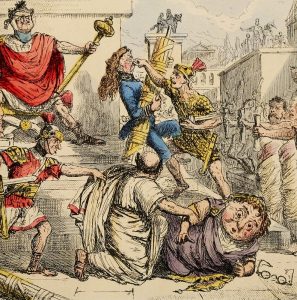
Item from John Leech'due south illustration "Tarquinius Superbus makes himself king" featured inThe Comic History of Rome – Internet Archive
At the beginning of the 1850s, ii stalwarts from the heart of London-based satirical magDial, Gilbert Abbott à Beckett and John Leech, bandage their mocking center a lilliputian further dorsum in time and publishedThe Comic History of Rome. Caroline Wazer explores how information technology is not in the text but rather in Leech's delightfully anachronistic illustrations that the book'southward true subversion lies, offering as they practise a critique of Victorian gild itself.

Past Dr. Carolyn Wazer
Ancient Historian
This article, The Eternal Guffaw: John Leech and The Comic History of Rome, was originally published in The Public Domain Review under a Creative Eatables Attribution-ShareAlike 3.0. If y'all wish to reuse information technology please see: https://publicdomainreview.org/legal/
Drawn by caricaturist John Leech, the illustrations of Gilbert Abbott à Beckett'southThe Comic History of Rome are a Victorian fever dream of ancient Rome. Senators pair their togas with top hats, generals wear muttonchops under their helmets, and priests styled as serpent charmers draw gullible crowds with the help of coal-powered rotating billboards. The blending of past and present in Leech's illustrations is on one level a simple visual joke that reinforces the sense of humor of the text, dragging the glories of Roman history down to the level of the contemporary London street. A closer look at the context of the book, however, reveals a series of interesting tensions beneath the surface humor.
Leech and à Beckett first worked together on the staff ofPunch, the satirical London periodical. Showtime published in 1841,Punch rapidly gained a reputation for capturing – and mocking – the cultural zeitgeist of Victorian London, from pompous politicians to the unwashed masses. Henry Argent, aPunch correspondent, wrote in his diary in 1864 that Leech "sneers at the Working Man, as usual." A staunch Tory, Leech oftentimes came into conflict with the more than progressive members of the earlyDial staff near the content of the magazine. His cartoons oftentimes portrayed the urban poor as stupid and the wealthy as frivolous. À Beckett, on the other hand, was a member of the progressive-minded Reform Guild and earned a reputation for understanding and generosity when he served as Poor Law commissioner in 1849.
By the time they collaborated onA Comic History of England in 1846, Leech and à Beckett had each already dabbled in the genre of satirical didactic literature. Leech had illustrated Percival Leigh'sThe Comic Latin Grammar andThe Comic English Grammer (both published in 1840), both of which were in-jokey publications for the elite schoolboy fix. À Beckett, drawing on his legal education, publishedThe Comic Blackstone in 1844. Brought out in monthly installments,A Comic History of England was a moderate success, and in 1851 the pair reunited forThe Comic History of Rome.
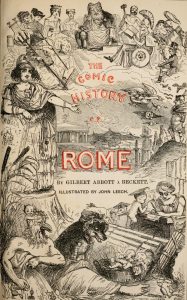
Title page forThe Comic History of Rome – Internet Annal
While neither Leech nor à Beckett had attended university, both received a classical master education. Amidst the growth of both capitalism and urbanism in the Victorian period, such an education was increasingly important as a cultural shibboleth, distinguishing aristocracy men from strivers when coin alone was no longer enough to exercise so. Around the fourth dimension of the nascence ofPunch, nonetheless, at that place arose a complicating factor to the employ of familiarity with the classical by: the at-abode educational publication. A upshot of cheap printing and increasing literacy, these publications – sort of the "For Dummies" books of their day – allowed anyone with a few pennies in his pocket admission to knowledge previously kept locked upward in elite schools.
ThePunch staff initially took an centre-rolling stance at this democratization – and cheapening – of history and learned culture. One issue from 1843 included a satirical feature titled "History at I View," which bundled major events according to the calendar month in which they occurred without regard to year, producing a nonsensical historical hodgepodge. The feature proclaimed itself to be "arranged expressly with an eye to the Social club for the Defoliation of Useful Knowledge," in a jab at the existent and very earnest Society for the Improvidence of Useful Knowledge. Other targets of ridicule included bad schoolboy Latin and popular retellings of Greek and Roman mythology.
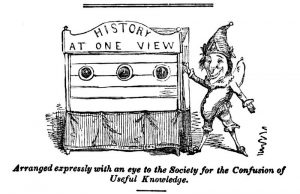
History at one view, from Punch vol. 5, no. 105, p.26 (1843) – Google Books
Dial soon stopped wrangling with the new climate of learning, at least in print. Some of the staff found this sneering attitude distasteful. As writer Douglas William Jerrold put information technology in an 1846 letter to his friend Charles Dickens, "The world will get tired (at to the lowest degree, I hope then) of this eternal guffaw at all things. After all, life has something serious in it. It cannot exist all a comic history of humanity."
À Beckett's preface toThe Comic History of Rome begins with a disclaimer. Despite the casual linguistic communication and jocular tone, "this work has been prompted by a very serious want to instruct those who, though willing to acquire information, seek in doing so equally much amusement equally possible." Men similar Jerrold who doubted the value of comic histories were "grievously mistaken who accept imagined that in this… the object has been to treat History as a mere farce, or to laugh at Truth."
For his part, à Beckett more often than not lived up to his word. He breezes through Roman history similar a professor emeritus at a cocktail party, displaying both a gently dry sense of humor and a deep familiarity with the content and tricky nature of the ancient sources. He closes the commencement chapter equally follows:
Before endmost this portion of the narrative of the History of Rome, it is necessary to warn the reader against assertive likewise much of information technology. The electric current legends are, indeed, Legenda, or things to exist read, because everybody is in the addiction of repeating them; but the student must baby-sit himself confronting placing credence in the old remark, that 'what everybody says must be truthful,' for here is a direct example of what everybody says being decidedly otherwise. The life and reign of Romulus, are to be taken not simplycum grano salis – with a grain of table salt – but with an unabridged cellar of that condiment, which is so useful in correcting the evil consequences of swallowing too much of anything.

"Romulus and Remus" – Internet Archive
Leech's images sometimes stick close to the text, as in the full-color plate that portrays the fable of Romulus and Remus as aMother Goose-esque fairy tale. Often, however, Leech used his illustrations to draw explicit and sometimes cut connections with mod Victorian life. The subject affair of the text, which covered Roman history through the autumn of the Commonwealth, certainly lent itself to comparisons with mid-nineteenth century London. Especially in the latter part of the period covered, Rome saw a booming poor urban population, the growth of a snobby urban intelligentsia, and the development of what many saw every bit overtly demagogical politics — in other words, the same things that Leech regularly skewered in the pages ofPunch.
The subject of Roman history allowed Leech to make some satirical references besides obscure or likewise reactionary forPunch'southward pages. A color plate portraying a 5th century BC popular uprising against the patrician Appius Claudius Crassus following his abduction of the plebeian Verginia resembles nothing then much equally a scene from the French Reign of Terror, complete with ragged street urchins and a stout cat-wielding proletarian wearing a Phrygian cap.
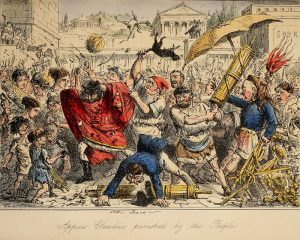
"Appius Claudius punished by the People" – Net Archive
More frequently, however, Leech used the Roman setting simply to poke fun at familiar urban characters, specially the working classes. In the images below, Leech portrays the revered Greco-Roman healing god Aesculapius as a crotchety old apothecary, and a Carthaginian soldier every bit a timid municipal policeman.
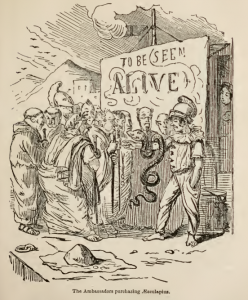

[LEFT]: Priests every bit snake charmers – Net Archive
[Correct]: Carthaginian policeman budgeted Marius – Internet Archive
Another favorite target was the rich homo who, whether out of desire for power or cultural cachet, overinvolved himself with the poor. In ane analogy, Tiberius Gracchus, a populist Roman reformer, becomes a top chapeau-wearing, infant-cheek-pinching demagogue, seedily winning popular favor by charming poor women.
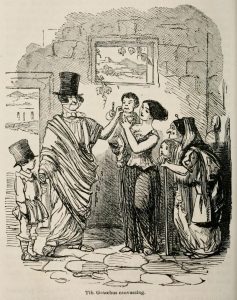
Tib. Gracchus canvassing – Cyberspace Archive
In another, Leech depicted a gladiator and his owner every bit a brutish modern-solar day boxer (note the gloves) and his foppish patron (note the dangling cigarette).

Early on Roman gladiator and patron – Internet Archive
Back atPunch, Leech had developed a reputation for overwhelming the text with the approachability and humour of his illustrations. William Makepeace Thackeray, who ofttimes contributed to the magazine, once wrote that "John Leech isPunch." A similar statement could be fabricated well-nighThe Comic History of Rome, despite à Beckett'south earnest assertion that the book was non meant to brand light of history. By projecting his satirical view of the nowadays back onto ancient Rome, Leech injected a sure nastiness intoThe Comic History of Rome that echoed and reinforced his nasty view of the nowadays.
Information technology is piece of cake enough to imagine a curious but uneducated centre-form Londoner enjoying à Beckett'southward avuncular jokes, merely what would he make of Leech'south illustrations? Perhaps he would be offended, simply possibly – conditioned byDialand similar publications – he would have part in Leech'due south eternal guffaw at order.
Works and Further Reading
The Comic History of Rome (1852), past Gilbert Abbott à Beckett, illustrated by John Leech.
John Leech: His Life and Work (1891), by William Powell Frith.
John Leech'south Pictures of Life and Character from the Drove of Mr.Punch(1887), by John leech.
THE Dial BROTHERHOOD: TABLE TALK AND PRINT CULTURE IN MID-VICTORIAN LONDON (British Library, 2010), past Patrick Leary
Comments
Source: https://brewminate.com/the-eternal-guffaw-john-leech-and-the-comic-history-of-rome/
0 Response to "Tarquinius Superbus Gardners Art Through the Ages Google Books"
Post a Comment