What Happen if You Didnt Finish the 24 Pieces for Ap Art Studio
Last Updated on February 24, 2022
These are a pick of works and commentaries from Ratthamnoon Prakitpong, a graduate from Thai Chinese International School in Bangkok, Thailand. Ratthamnoon was i of sixteen students worldwide to receive a score of 100% for his AP Studio Art Cartoon Portfolio in 2015, earning every point possible on each portion of his portfolio. His portfolio scored a perfect six.


AP Studio Art: Breadth
The Breadth section of the AP Studio Art portfolio is a great chance to brush up on skills and experiment. The Breadth section of the portfolio consists of 12 works of art that demonstrate a mastery of skills whilst showing the artistic range of a educatee. Hither are some examples of what I did to make my piece of work better and more personal:
The importance of a adept composition

For this class project, we had to work on transparent textures. Having strong painting skills is of import; having a strong limerick to work from equally and so. The first batch of preliminary images I did were indoors with two wine glasses. I felt like the contrast and depth were sufficient, but my teacher, Elizabeth Jendek, asked me to attempt other kinds of glass to brand the composition more interesting. I took loads of photos to find compositions that worked. On the second and 3rd preliminary compositions I presented to my teacher, the light was indoors and the drinking glass didn't have reflective areas. The third composition was better because of the outdoor low-cal, but information technology still wasn't great.
Then my teacher suggested I photograph outside in sunset. Existence outside made the still life look more natural and lively; these effects were emphasized by the striped cloth, which increased movement. In addition, the sunset's orange light actually heightened the spectacles' shine and contrast. With the table's directional line, I got the depth dorsum from the beginning composition that was lost during the second and third tries. My composition was stiff considering my focal point was to the side, which follows the dominion of thirds: in that location were size relationships showing depth and perspective. At that place likewise was variation past color and shape, making the composition more stimulating. A potent composition illuminated my skill of painting. Although this is a drawing portfolio, a expert composition is as important as your great skill of painting in and of itself. To get the all-time compositions, I questioned myself; I didn't expect things to work out the very first time, listened to my peers and teacher's communication, and kept working on it until I got the best composition.
Revisiting work makes a big difference
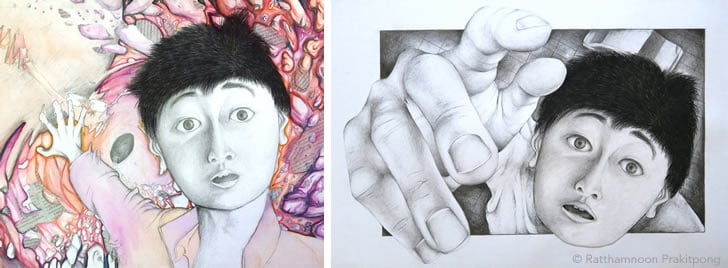
As my skills improved, I constitute that some of my piece of work looked a little uneven. I had a portrait that I did earlier, which no longer matched the skill level of my other work. Since the confront was working fine, the teacher and I discussed the idea of cutting and pasting the caput onto a new image. I took a few photos and did a new limerick in Photoshop and came up with a new image. Once I was confident with my new idea, I sketched out my new composition on fresh paper, cut out the face and glued it to the new composition. My new version was much meliorate and it evened upward my skill level throughout the portfolio in my concluding submission.
I took calculated risks with time and limerick. I scheduled my fourth dimension well and used all the good guidance and technology available to finish this drawing. It turned out to be one of my favorites.
Sometimes abandoning a work of art is improve than to keep fighting it
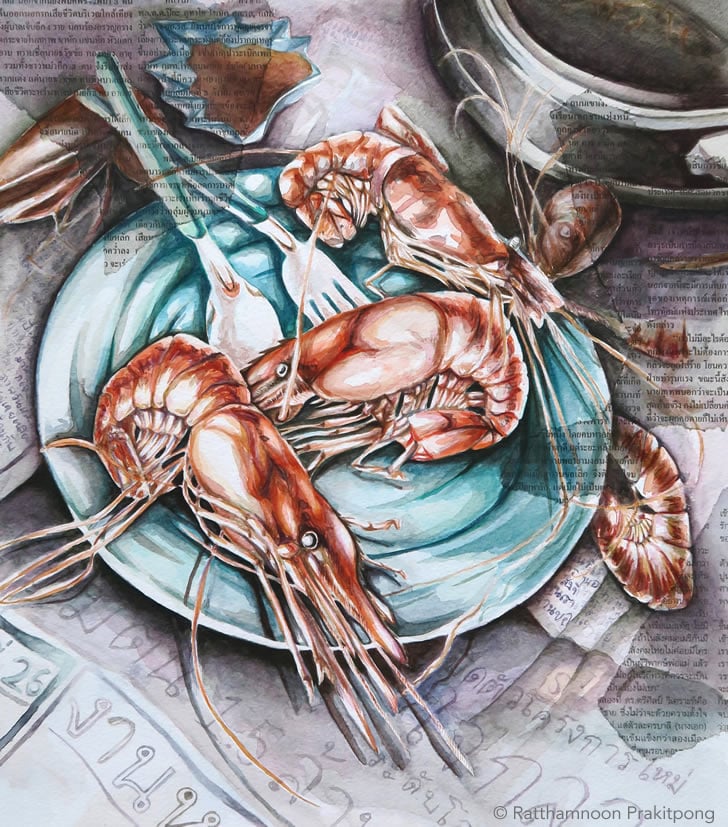
While I was doing my portfolio, I had a few compositions that needed reworking – one in particular actually merely wasn't working out. I tried calculation more to the composition; I did loads of preliminary sketches, and finally decided I was getting nowhere. After discussing and problem-solving with my instructor, we decided it would be better to offset a fresh new artwork based off an alternative lesson. It's true that information technology was hard to let get of so much work already washed, and the new project was every bit challenging, merely information technology worked much better than if I would've continued beating a dead horse.
To recoup for lost efforts, I tried to add together my ain personal touches to this fine art piece. Even though the dark-green plate tin exist seen just as a nice dissimilarity to the orangish shrimp, it's besides the aforementioned plate my family unit uses when nosotros exit picnicking. We usually lay one-time newspapers underneath our seafood so that mess won't spill anywhere. I took direct inspiration from that, and glued newspaper onto my work for texture; to finish, I copied Thai messages onto the composition. By adding my ain personal touch, this simple projection became more unique, and much richer. They were my shrimp, and this is how I eat them.
Look for inspiration around you, in unlikely places

Friends and I went on a hiking trip to Phu Kradueng. In this expanse of Thailand, automated services aren't bachelor, so local couriers offer their services by carrying huge loads to the top of the mountain expanse. Watching these men lift such enormous amounts was inspirational, and I took this great photo capturing their strength and dazzler – it reminded me of Greek Gods. Although this wasn't a class project, I painted it on my own anyway for two reasons: the tourist sight was so unique, and it was as well an important memory for my friends and I. To further the personal nature of this paradigm, I glued my train ticket to the composition to further add to that feeling of a snap in time, fully enclosing the character of the place and to add additional texture.
AP Studio Art: Concentration
Concentration is a section where I focused on a specific topic and many art skills. It'due south very intense and pressuring. Here I commented on a few skills that I focused on to make my Concentration more successful:
Picking the right Concentration topic is incredibly of import
Since the Concentration section needed twelve pieces based on a single topic, my instructor advised the course to look long and hard for a topic that had room for development and exploration, withal remained accessible. It took me a few months, only I settled on a Concentration topic most dissimilar perspective-based portraits in the kitchen.
Thematically, I picked this topic because I was already a hobbyist cook, and wanted to combine and explore the ii things that I liked – art and cooking. I feel, in my country, at that place's a cultural stigma about men in the kitchen that I wanted to both question and eradicate past demonstrating that men can cook as well as anyone else.
I decided to pursue portraits and create variation using different perspectives and color schemes. For my take on perspective, I used a selfie stick to find new perspective and angles. Where my hands were holding the camera, I superimposed kitchen tools – spoons, forks, spatulas – to hide the selfie stick in the drawing. As for the kitchen itself, I constitute inspiration from my personal exploration in using new kitchen tools, like cooking noodles for my lunch box or eggs in the morning. These were additional considerations I made when selecting this topic:
- My exploration was not just visual, but personal too. It showed my evolution as an creative person and a thinker. I merely had effectually five ideas at the beginning because I wasn't familiar with the kitchen, but as I personally explored the kitchen more, inspiration came naturally.
- I cared nearly my topic. I was exploring my hobby and my civilization. If I wasn't passionate about my topic, past the 8th or 9th image I would've hated my work. Artwork without passion is credible.
- It was visually appealing. Even though my personal story and passion were there, my Concentration wouldn't be as strong if I did not play with perspectives and color schemes. I was really experimental about information technology too, and when the compositions didn't work, they all the same served as a springboard for the next thought.
- My topic was versatile enough to have twelve different ideas united nether it. The kitchen has interesting tools, objects and angles I could use to experiment. That kept my thought fresh, yet united.
- My topic was flexible. Choosing my kitchen as a basis for my topic might seem simple, but it provided enough room for experimenting with techniques that weren't necessarily kitchen-related, like superimposition or collage.
- My topic was accessible. I could go back easily to the kitchen and photograph some more, or look for other inspirations. This made a huge divergence when some compositions needed more reworking than others.
(If you are struggling to come upward with your ain AP Studio Art Concentration ideas, please read: Fine art Project Ideas: a guide to subject thing selection).
Here are some examples of how I problem-solved composition concerns, increased depth, and manipulated my imagery.
I experimented with depth

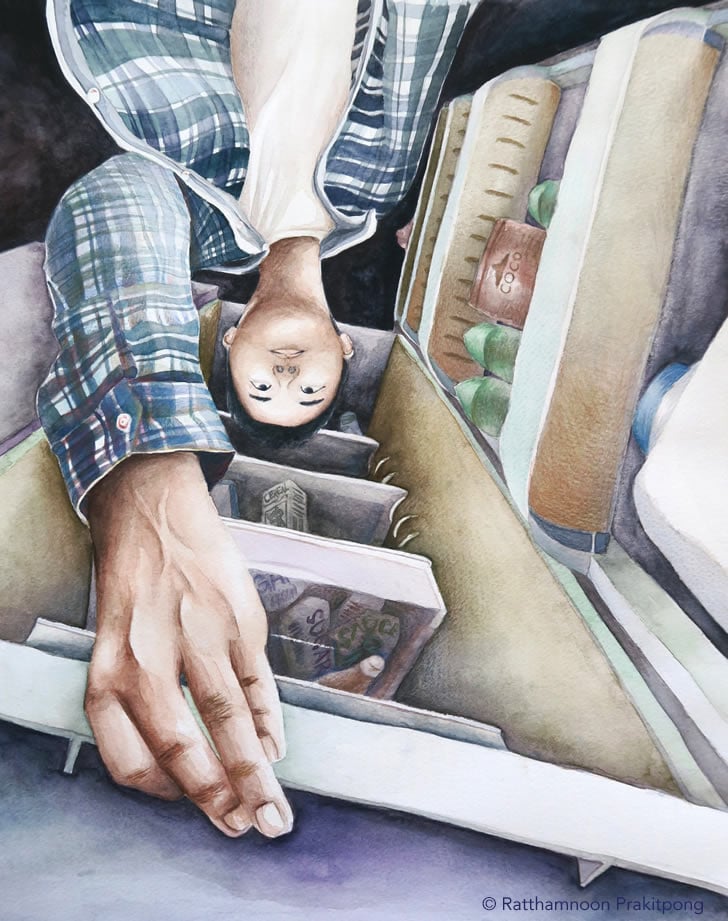
I increased depth with my selfie stick; it gave me more options with regards to angles. The first limerick in which I used the stick didn't quite capture what I wanted, so I added an additional shelf at the top of my composition to increase depth. I used a fisheye lens to make the composition more interesting, and changed the hands that held the selfie stick altogether. I also manipulated color from the originally banal white into a triad color scheme to brand it more than visually dynamic.
Combining multiple skills enriches your art
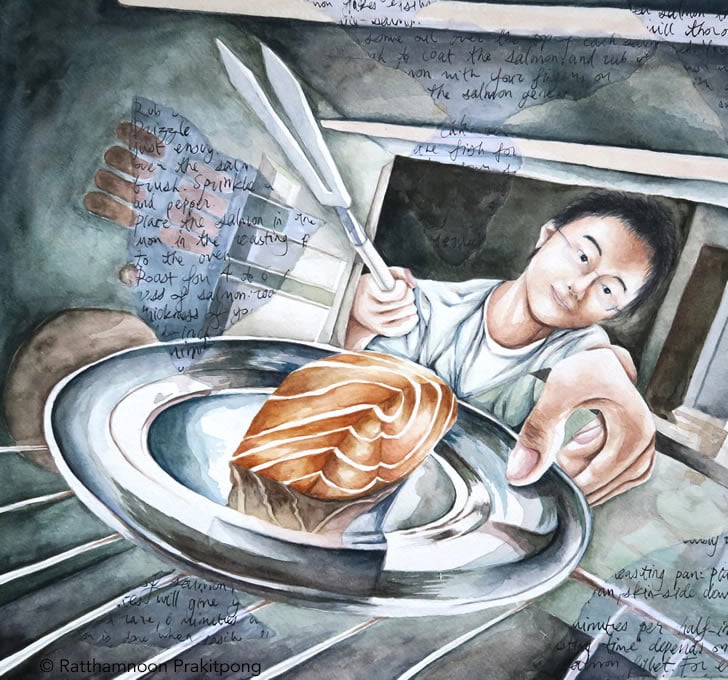
I had already used bird's centre and worm'south eye of view, and so I had to come up upward with something unique for this one. When I looked at the oven, I remembered when my female parent broiled and thought of her delighted face when she pulled out her blistering. And so I decided to render some freshly baked nutrient and the serenity on someone's face up when they first meet the food. This gave my epitome more personal pregnant. I also added pieces of a hand written recipe for texture and to increase movement. Additionally, I superimposed a meat fork where my selfie stick had been.
Final thoughts
In hindsight, I fabricated many gutsy moves, and I failed – a lot. However, I succeeded a lot too. Information technology actually came down to commitment, to practice, to having many chances to fail and, in plough, to succeed. I made more than 24 art pieces, but I got to choose the ones I was actually proud of for a trimmed version of my portfolio. Nearly chiefly, I'grand just another person, and what I did may not apply to yous. Listen to the people who know you lot, who are close to you – your teacher, your peers, and yourself. There's no point in making anything unless you will exist proud of information technology. That means sometimes an unyielding stance, or sometimes blind religion in communication.

This AP Studio Fine art Drawing course was taught past Elizabeth Jendek. Work from her students is used by Alison Youkilis, an AP Art teacher trainer, to teach other educators around the world. Yous can see additional outstanding artworks by Elizabeth Jendek'south students in the article: 50+ All the same life drawing ideas for art students.
This loftier schoolhouse fine art projection was shared with our audience so that other students may benefit from the ideas, techniques and approaches used. We celebrate the endeavour and achievement of high schoolhouse students and Fine art Departments around the world. If you would similar to share your ain art project (or that of your students), delight read our submission guidelines.
Source: https://www.studentartguide.com/featured/ap-studio-art-drawing-portfolio-2
0 Response to "What Happen if You Didnt Finish the 24 Pieces for Ap Art Studio"
Post a Comment