How Do You Know Where the File Is Written to in Java
This page discusses the details of reading, writing, creating, and opening files. At that place are a broad array of file I/O methods to cull from. To help make sense of the API, the following diagram arranges the file I/O methods by complexity.
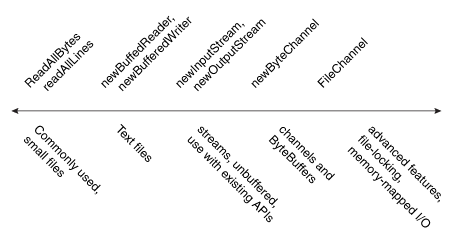
On the far left of the diagram are the utility methods readAllBytes, readAllLines, and the write methods, designed for elementary, common cases. To the right of those are the methods used to iterate over a stream or lines of text, such equally newBufferedReader, newBufferedWriter, then newInputStream and newOutputStream. These methods are interoperable with the coffee.io package. To the right of those are the methods for dealing with ByteChannels, SeekableByteChannels, and ByteBuffers, such equally the newByteChannel method. Finally, on the far correct are the methods that use FileChannel for avant-garde applications needing file locking or memory-mapped I/O.
Note: The methods for creating a new file enable you lot to specify an optional set of initial attributes for the file. For example, on a file arrangement that supports the POSIX gear up of standards (such as UNIX), you tin specify a file owner, group owner, or file permissions at the fourth dimension the file is created. The Managing Metadata page explains file attributes, and how to access and set them.
This page has the following topics:
- The
OpenOptionsParameter - Commonly Used Methods for Pocket-size Files
- Buffered I/O Methods for Text Files
- Methods for Unbuffered Streams and Interoperable with
java.ioAPIs - Methods for Channels and
ByteBuffers - Methods for Creating Regular and Temporary Files
The OpenOptions Parameter
Several of the methods in this section take an optional OpenOptions parameter. This parameter is optional and the API tells yous what the default beliefs is for the method when none is specified.
The following StandardOpenOptions enums are supported:
-
WRITE– Opens the file for write access. -
Suspend– Appends the new data to the end of the file. This option is used with theWRITEorCREATEoptions. -
TRUNCATE_EXISTING– Truncates the file to nada bytes. This option is used with theWRITEselection. -
CREATE_NEW– Creates a new file and throws an exception if the file already exists. -
CREATE– Opens the file if it exists or creates a new file if it does not. -
DELETE_ON_CLOSE– Deletes the file when the stream is closed. This option is useful for temporary files. -
SPARSE– Hints that a newly created file will be thin. This advanced option is honored on some file systems, such as NTFS, where large files with information "gaps" can be stored in a more than efficient manner where those empty gaps do not consume deejay space. -
SYNC– Keeps the file (both content and metadata) synchronized with the underlying storage device. -
DSYNC– Keeps the file content synchronized with the underlying storage device.
Usually Used Methods for Small-scale Files
Reading All Bytes or Lines from a File
If yous have a small-ish file and you would like to read its entire contents in one pass, you tin use the readAllBytes(Path) or readAllLines(Path, Charset) method. These methods take care of well-nigh of the work for you, such as opening and closing the stream, but are non intended for handling large files. The following lawmaking shows how to use the readAllBytes method:
Path file = ...; byte[] fileArray; fileArray = Files.readAllBytes(file);
Writing All Bytes or Lines to a File
You can employ one of the write methods to write bytes, or lines, to a file.
-
write(Path, byte[], OpenOption...) -
write(Path, Iterable< extends CharSequence>, Charset, OpenOption...)
The following code snippet shows how to utilise a write method.
Path file = ...; byte[] buf = ...; Files.write(file, buf);
Buffered I/O Methods for Text Files
The coffee.nio.file package supports channel I/O, which moves data in buffers, bypassing some of the layers that can bottleneck stream I/O.
Reading a File by Using Buffered Stream I/O
The newBufferedReader(Path, Charset) method opens a file for reading, returning a BufferedReader that can be used to read text from a file in an efficient way.
The post-obit code snippet shows how to utilise the newBufferedReader method to read from a file. The file is encoded in "Us-ASCII."
Charset charset = Charset.forName("US-ASCII"); endeavor (BufferedReader reader = Files.newBufferedReader(file, charset)) { String line = null; while ((line = reader.readLine()) != zero) { System.out.println(line); } } take hold of (IOException 10) { System.err.format("IOException: %s%due north", x); } Writing a File by Using Buffered Stream I/O
Yous can use the newBufferedWriter(Path, Charset, OpenOption...) method to write to a file using a BufferedWriter.
The following lawmaking snippet shows how to create a file encoded in "US-ASCII" using this method:
Charset charset = Charset.forName("US-ASCII"); Cord due south = ...; endeavor (BufferedWriter writer = Files.newBufferedWriter(file, charset)) { writer.write(southward, 0, s.length()); } catch (IOException ten) { System.err.format("IOException: %s%north", 10); } Methods for Unbuffered Streams and Interoperable with java.io APIs
Reading a File by Using Stream I/O
To open a file for reading, you can use the newInputStream(Path, OpenOption...) method. This method returns an unbuffered input stream for reading bytes from the file.
Path file = ...; try (InputStream in = Files.newInputStream(file); BufferedReader reader = new BufferedReader(new InputStreamReader(in))) { String line = null; while ((line = reader.readLine()) != zippo) { System.out.println(line); } } grab (IOException x) { System.err.println(x); } Creating and Writing a File by Using Stream I/O
You can create a file, append to a file, or write to a file by using the newOutputStream(Path, OpenOption...) method. This method opens or creates a file for writing bytes and returns an unbuffered output stream.
The method takes an optional OpenOption parameter. If no open up options are specified, and the file does not exist, a new file is created. If the file exists, it is truncated. This pick is equivalent to invoking the method with the CREATE and TRUNCATE_EXISTING options.
The following example opens a log file. If the file does not be, it is created. If the file exists, it is opened for appending.
import static java.nio.file.StandardOpenOption.*; import coffee.nio.file.*; import java.io.*; public grade LogFileTest { public static void master(String[] args) { // Catechumen the string to a // byte array. Cord southward = "How-do-you-do World! "; byte data[] = south.getBytes(); Path p = Paths.get("./logfile.txt"); try (OutputStream out = new BufferedOutputStream( Files.newOutputStream(p, CREATE, Append))) { out.write(data, 0, data.length); } catch (IOException x) { Organisation.err.println(x); } } } Methods for Channels and ByteBuffers
Reading and Writing Files by Using Channel I/O
While stream I/O reads a grapheme at a time, channel I/O reads a buffer at a time. The ByteChannel interface provides basic read and write functionality. A SeekableByteChannel is a ByteChannel that has the capability to maintain a position in the channel and to change that position. A SeekableByteChannel too supports truncating the file associated with the channel and querying the file for its size.
The capability to movement to unlike points in the file then read from or write to that location makes random access of a file possible. Come across Random Access Files for more information.
At that place are two methods for reading and writing aqueduct I/O.
-
newByteChannel(Path, OpenOption...) -
newByteChannel(Path, Set<? extends OpenOption>, FileAttribute<?>...)
Note: The newByteChannel methods return an example of a SeekableByteChannel. With a default file arrangement, you tin cast this seekable byte aqueduct to a FileChannel providing access to more advanced features such mapping a region of the file straight into retentiveness for faster access, locking a region of the file so other processes cannot admission it, or reading and writing bytes from an absolute position without affecting the channel's current position.
Both newByteChannel methods enable you to specify a list of OpenOption options. The same open up options used by the newOutputStream methods are supported, in improver to one more than choice: READ is required considering the SeekableByteChannel supports both reading and writing.
Specifying READ opens the channel for reading. Specifying WRITE or APPEND opens the aqueduct for writing. If none of these options are specified, then the aqueduct is opened for reading.
The following code snippet reads a file and prints it to standard output:
public static void readFile(Path path) throws IOException { // Files.newByteChannel() defaults to StandardOpenOption.READ attempt (SeekableByteChannel sbc = Files.newByteChannel(path)) { final int BUFFER_CAPACITY = 10; ByteBuffer buf = ByteBuffer.allocate(BUFFER_CAPACITY); // Read the bytes with the proper encoding for this platform. If // you skip this step, y'all might see foreign or illegible // characters. String encoding = System.getProperty("file.encoding"); while (sbc.read(buf) > 0) { buf.flip(); System.out.print(Charset.forName(encoding).decode(buf)); buf.clear(); } } } The following instance, written for UNIX and other POSIX file systems, creates a log file with a specific fix of file permissions. This code creates a log file or appends to the log file if it already exists. The log file is created with read/write permissions for owner and read merely permissions for grouping.
import static java.nio.file.StandardOpenOption.*; import java.nio.*; import coffee.nio.channels.*; import java.nio.file.*; import java.nio.file.attribute.*; import coffee.io.*; import java.util.*; public class LogFilePermissionsTest { public static void main(String[] args) { // Create the ready of options for appending to the file. Set<OpenOption> options = new HashSet<OpenOption>(); options.add(APPEND); options.add together(CREATE); // Create the custom permissions attribute. Gear up<PosixFilePermission> perms = PosixFilePermissions.fromString("rw-r-----"); FileAttribute<Fix<PosixFilePermission>> attr = PosixFilePermissions.asFileAttribute(perms); // Convert the string to a ByteBuffer. String s = "Howdy World! "; byte data[] = s.getBytes(); ByteBuffer bb = ByteBuffer.wrap(data); Path file = Paths.get("./permissions.log"); try (SeekableByteChannel sbc = Files.newByteChannel(file, options, attr)) { sbc.write(bb); } catch (IOException ten) { Organization.out.println("Exception thrown: " + ten); } } } Methods for Creating Regular and Temporary Files
Creating Files
Y'all tin can create an empty file with an initial set of attributes past using the createFile(Path, FileAttribute<?>) method. For example, if, at the fourth dimension of cosmos, y'all want a file to take a particular prepare of file permissions, use the createFile method to practice and so. If you lot do not specify any attributes, the file is created with default attributes. If the file already exists, createFile throws an exception.
In a single atomic operation, the createFile method checks for the existence of the file and creates that file with the specified attributes, which makes the procedure more than secure against malicious lawmaking.
The following lawmaking snippet creates a file with default attributes:
Path file = ...; effort { // Create the empty file with default permissions, etc. Files.createFile(file); } catch (FileAlreadyExistsException x) { Organization.err.format("file named %s" + " already exists%n", file); } take hold of (IOException x) { // Some other sort of failure, such as permissions. System.err.format("createFile error: %s%northward", x); } POSIX File Permissions has an example that uses createFile(Path, FileAttribute<?>) to create a file with pre-set up permissions.
You can also create a new file by using the newOutputStream methods, equally described in Creating and Writing a File using Stream I/O. If you open up a new output stream and close it immediately, an empty file is created.
Creating Temporary Files
You can create a temporary file using one of the following createTempFile methods:
-
createTempFile(Path, Cord, String, FileAttribute<?>) -
createTempFile(String, String, FileAttribute<?>)
The first method allows the lawmaking to specify a directory for the temporary file and the second method creates a new file in the default temporary-file directory. Both methods allow you to specify a suffix for the filename and the first method allows y'all to also specify a prefix. The following lawmaking snippet gives an instance of the second method:
try { Path tempFile = Files.createTempFile(null, ".myapp"); Organisation.out.format("The temporary file" + " has been created: %s%n", tempFile) ; } take hold of (IOException x) { Organization.err.format("IOException: %s%n", x); } The consequence of running this file would be something like the following:
The temporary file has been created: /tmp/509668702974537184.myapp
The specific format of the temporary file name is platform specific.
Source: https://docs.oracle.com/javase/tutorial/essential/io/file.html
0 Response to "How Do You Know Where the File Is Written to in Java"
Post a Comment